Self referral

Back pain is very common. About 80% of people will get it at some point.
You might feel pain only in your back, or it might spread down one or both legs. Some people also get tingling, pins and needles, or numbness.
Most back pain gets better within 2–3 months, although it may not go away completely. A small number of people (about 1 in 100) need extra help from specialists like physiotherapists or pain clinics. Very few people (less than 1 in 1,000) need surgery.
Back pain can happen for many reasons, including:
These include slips, trips, falls, or car accidents. If you get back pain after this, it is often called whiplash. It usually gets better with gentle movement, pain relief, and time.
Tiredness (fatigue): When your body or mind is tired, everything feels more sensitive, including pain.
Some painkillers can actually make pain worse if used for a long time. One group, called opioids, can increase back pain when taken for too long.
Usually no. Most back pain improves within 12–14 weeks.
If your pain hasn’t improved after 6–8 weeks, it’s worth speaking to a professional such as a First Contact Physiotherapist at your GP surgery. You can also self‑refer to the CDDiMSK service.
Very rarely, back pain can be a sign of something more serious, such as:
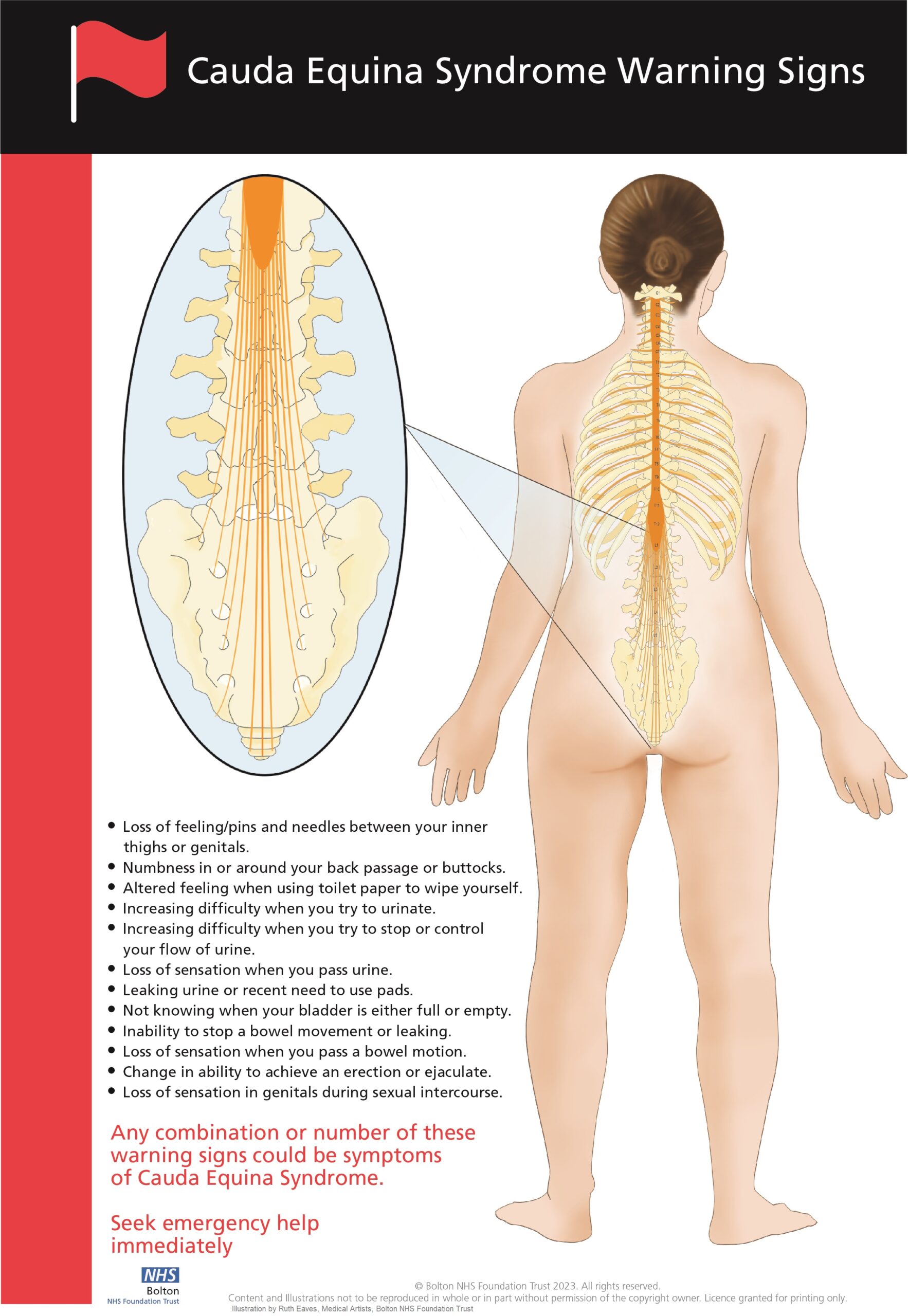
Cauda equina syndrome (about 3 in 100,000 people)
A serious illness (0.4–2 in 100,000 people)
It is when important nerves at the bottom of your spine get squashed. These nerves help you move your legs, feel around your bottom and private parts, and know when you need the toilet.
Contact your GP as soon as possible if you have:
Pain that never changes — it doesn’t get better or worse no matter what you do.
Back pain with sudden weight loss without trying.
Sudden pain in both legs at the same time, even though nothing happened. Or if long‑term pain in one leg suddenly starts in the other leg too.
Weakness in both legs at the same time.
Pins and needles, numbness, or tingling in your genitals, anus, or the skin between them (the perineum). This may happen with or without changes to your bladder or bowel.
Probably not.
An MRI scan shows a still picture of your body while you lie down. It cannot show how your back moves, so it often doesn’t explain why you have pain.
For most people:
An MRI does not change the treatment plan.
It can sometimes delay recovery or even make symptoms feel worse.
MRI scans are mainly useful for:
Surgery is not usually a good way to treat back pain. About 3 out of 10 people who have back surgery end up with worse pain or new pain afterwards.

The best treatment for back pain is movement.
This could be:
Walking
Gentle exercise
Gym classes
Anything that feels comfortable for you
Even during a bad flare‑up, try to move as much as your pain allows
You can also:
Ask your GP or First Contact Physiotherapist about exercises and suitable pain relief
Self‑refer to CDDiMSK if things haven’t improved after 6 weeks


Don’t blame yourself or “fight” the pain. Pain is not a sign of weakness.
Don’t assume long‑lasting pain means damage. You can be sore but still safe to move.
Don’t panic if you have a flare‑up. Good and bad days are normal.
Don’t believe everything you read online. Many treatments have no evidence behind them.
Don’t rely on scans. Many people with no pain at all have changes on MRI scans. For example, disc bulges are found in:
40% of people over 30
50% of people over 40
Back pain is very common
It is almost never caused by something serious
Keep moving as much as you can
MRI scans rarely explain back pain
Surgery is almost never needed for low back pain
If your pain hasn’t improved after 6–8 weeks, contact your GP or use the self‑referral link