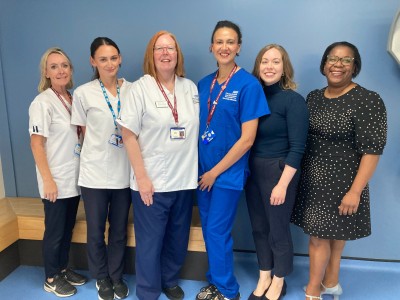
A specialist service supporting women and birthing people with pelvic health during pregnancy and after birth is celebrating its first anniversary after receiving more than 2,000 referrals in its first year.
The Perinatal Pelvic Health Service at County Durham and Darlington NHS Foundation Trust (CDDFT) provides personalised advice, assessment and treatment for women and birthing people from the start of pregnancy until one year after giving birth.
The service was launched in September 2025 with support from NHS England funding and in partnership with the Local Maternity and Neonatal System.
Andrea Longden, Lead Midwife for Perinatal Pelvic Health and Clinical Education at CDDFT, said: “It has been fantastic to see how much the service has grown over the past year. More than 2,000 people have been referred to our specialist team, showing the real need for accessible pelvic health support during pregnancy and after birth.
“We are incredibly proud of what the team has achieved. Alongside providing individual support and treatment, we have worked closely with maternity colleagues to raise awareness, share knowledge and strengthen pelvic health care across our services. It is wonderful to know that women and birthing people are getting the help they need to feel more confident, recover well and improve their quality of life.”
The specialist team provides support for a wide range of pelvic health concerns, including urinary and bowel problems, pelvic girdle pain, pelvic floor dysfunction, prolapse symptoms, pain during or after sex, perineal tears and separated tummy muscles.
Support is available through telephone assessments, group sessions including advice and exercise, and one-to-one face-to-face appointments.
Over the past year, the service has also introduced a new Obstetric Anal Sphincter Injury (OASI) clinic at Bishop Auckland Hospital, providing specialist follow-up for women and birthing people who have experienced a third- or fourth-degree tear during childbirth.
The team has also delivered regular staff training on Obstetric Anal Sphincter Injury (OASI) which is a severe third- or fourth-degree perineal tear and pelvic dysfunction, helping colleagues develop their knowledge and skills and supporting best practice in the prevention and management of pelvic health problems.
As part of this work, the rate of third- and fourth-degree tears has reduced from 2.7% to 1.7% over the past year, compared with a reported UK average of 2.9%.
The service also runs weekly Pilates exercise and advice classes and offers women and birthing people the opportunity to self-refer directly to specialist pelvic health physiotherapists.
Andrea added: “Pelvic health can sometimes be a difficult subject to talk about, and women and birthing people may not always realise that symptoms such as bladder or bowel problems, pelvic pain or discomfort following birth are things they can get help with.
“Our message is simple: you do not have to put up with symptoms or suffer in silence. We want women and birthing people to know that support is available, and we are here to help them through pregnancy and the first year after their baby is born.
“Thank you to everyone across maternity and our wider services who has supported the development of pelvic health care over the past year. This has been a real team effort, and we are excited about continuing to build on what we have achieved.”
The service has received positive feedback from those who have accessed support, with patients highlighting improvements in strength, confidence, function and physical and emotional wellbeing.
One woman described the service as “game changing”, while another said the group physiotherapy and Pilates sessions helped her regain function, improve her wellbeing and feel more confident following birth.
The Perinatal Pelvic Health Service is available to women and birthing people from the start of pregnancy until one year after giving birth. Women and birthing people can self-refer to the service through the CDDFT website.